
Services
To meet customer performance targets and drive operational competitiveness will require the active involvement and teamwork of multiple functions in the business. Successful programmes typically require a blend of discrete and combined improvement activities.
Those that don’t recognise this tend to turn into ‘initiatives’ where tools are applied but teams struggle to see benefit.
The AS Compete approach works to understand the factors affecting performance through a combination of assessment and value stream analysis, enabling the full picture and all the interactions to be seen.
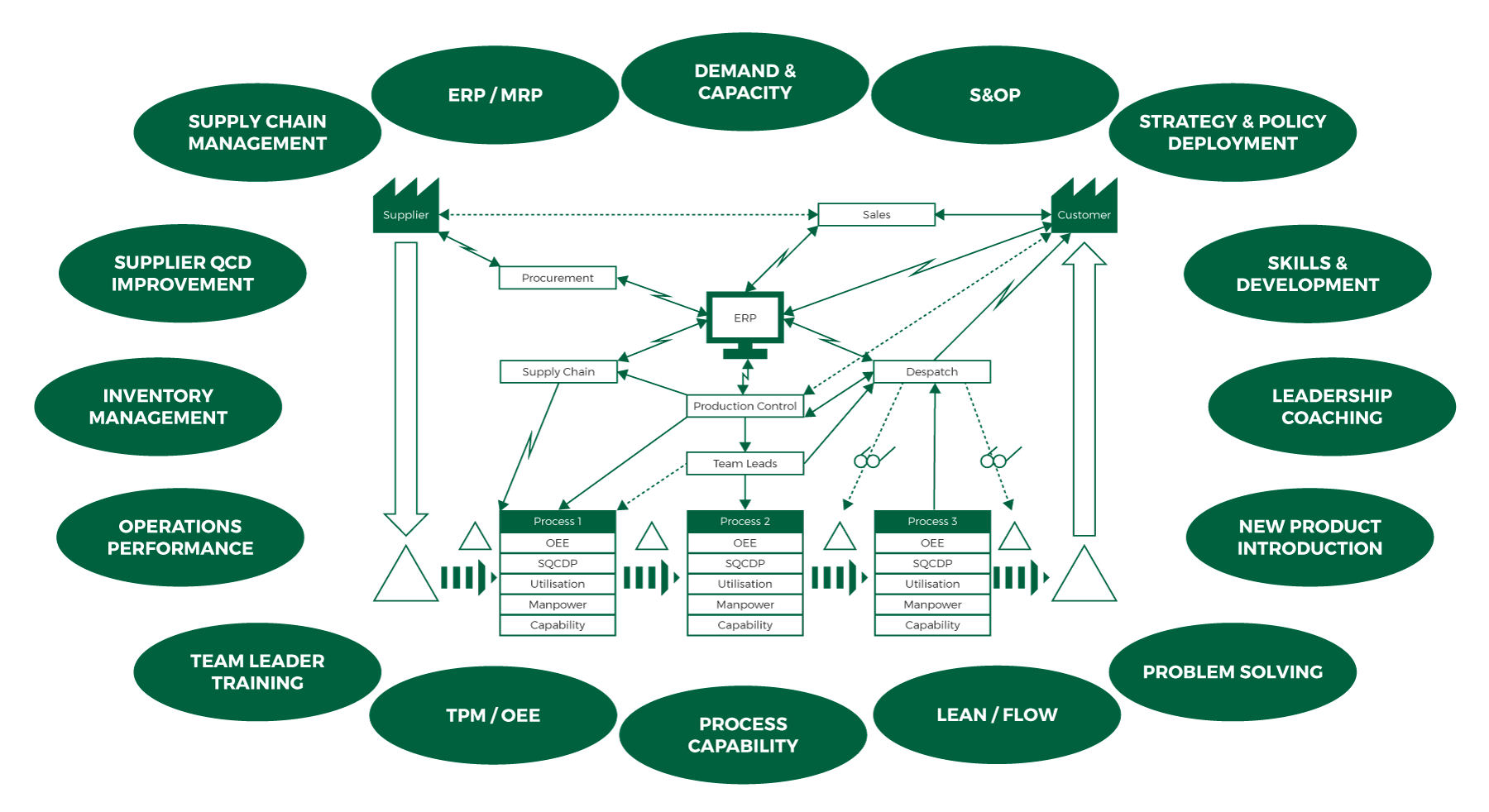
Click image to enlarge
Assessment and improvement activates can be conducted through a variety of techniques, individually or in combination, as introduced below. The priority is to ensure that the approach fits the business context and will deliver the needs of the client.
The Business Assessment looks across the different functions in your organisation, working with the teams who own the processes, in order to understand the strengths and opportunities. It is important that assessments are seen as a chance to explore the potential for improvement, not to defend the current situation in the way audits tend to.
Understanding the business processes in this way enables a capability rating to be established, improvement areas prioritised and integrated programmes developed to maximise benefit. The Business Assessment is particularly powerful when delivered in conjunction with Value Stream Mapping of operations to deliver a full, rounded picture supported by data.
Where clients wish to focus on a specific business area more detailed assessment can be conducted, often supported by value stream or process maps. For a larger facility the same detail assessment can be conducted in multiple areas (e.g. different production cells) to prioritise improvement needs.
Andy was the lead author and Master Assessor trainer for the assessment process that underpinned the UK government funded, national automotive and aerospace supply chain improvement programmes (NMCL and SC21 C&G) between 2018 and 2022.
Value Stream Mapping, supported by data analysis, provides a method to visualise and understand where the threats and opportunities are across both the material flow and the information flow that drives it.
By Value Stream Mapping your processes we identify which improvements, individually or in combination, will drive improvements to performance and efficiency. Too often manufacturing focussed activities drive nominal benefits that can’t be realised without improvement and alignment of other operations and support processes.
Our approach ensures that material and information flows are stabilised and that achievable future states are developed, meeting your strategic requirements.
Andy has been utilising the Value Stream Mapping approach with clients since shortly after the publication of the definitive ‘Learning to See’ by Rother and Shook.
Continuous Process Improvement (CPI), now often know as Lean, focusses on the elimination of waste from processes so that they are capable of achieving the best, safe, process that delivers quality and delivery requirements at optimum cost.
Tools typically used with Lean activities include Data analysis, 5S Workplace organisation, 7 Wastes, Visual Management and Standard work as well as Problem Solving, Set Up Improvement and Line Balance techniques.
Lean improvement activities are delivered at all levels – individual daily actions, tackling repeating issues and driving step change performance, through to fundamental process or system redesign.
Critical to all Lean activities are the engagement and participation of those who do the focus task, management support to ensure actions can be implemented, use of data to ensure that activity is driving impact and the Plan, Do, Check, Act cycle to ensure that we understand, embed, sustain and continuously improve.
Andy originally trained in these techniques working with Japanese Master Engineers from Honda, Nissan and Toyota over 20 years ago and has been using them to drive benefit for clients ever since, adapting the implementation to meet the needs of different industrial complexities and volumes of supply.
The best manufacturing processes will not deliver performance if demand requirements, production plans and material availability is not coordinated effectively. Enterprise Resource Planning (ERP) systems are often poorly implemented with limited understanding and lead to teams using manual or Excel based approaches to provide workarounds.
AS Compete works with your team to understand how these processes can be improved and ERP software used better, ensuring material and production planning meets customer requirement. These follow the flow from Sales and Operation Planning (S&OP), into Demand and Capacity planning, generating Materials Requirement Planning (MRP), ensuring effective Inventory Management and finally production scheduling. Activities review your existing ERP systems, driving improvements to the data quality and ensuring most effective and appropriate use.
With a degree in Manufacturing Engineering and extensive production control and management experience, Andy is ideally placed to help you get the best from your planning system.
We are not ERP systems implementation experts but, if you are looking to implement a new ERP system, can work with you to help ensure the correct inputs and user stories are captured in preparation.
Total Productive Maintenance (TPM), drives optimum equipment performance by focussing on the elimination of losses (safety, defects and downtime). TPM programmes are normally focussed on driving the Overall Equipment Effectiveness (OEE) measure, driving Availability, Performance and Quality. The approach follows a pillar led and step based structure using Focussed Improvement, Autonomous Maintenance, Planned Maintenance and Training / Education to drive understanding of and elimination of losses. Operations and Maintenance teams work together to drive the improvement, moving from the typical ‘fix and forget’ mentality seen in many facilities to proactive prevention and, with the introduction of further pillars, to the optimisation of equipment performance.
Andy was originally taught the technique of TPM by trainers from the Japanese Institute of Plant Maintenance (JIPM) and has implemented the approach multiple times in sectors ranging from food and drink to fertiliser manufacture. Andy can lead TPM implementation both aligned to the pure JIPM 8 pillar philosophy or more pragmatically employed in companies where the full approach may be overwhelming.
Many organisations find that their internal planning and manufacturing processes are constrained by the performance of suppliers. Quality issues lead to excessive incoming inspection, disruption to manufacturing, online rework and often impact customer deliveries. Suppliers who don’t plan effectively and operate efficiently struggle to deliver on time at the required volume and in a short enough lead-time.
Many business select suppliers based on simple questionnaire responses and then make decisions dominated by price, often leading to much higher costs overall than the procurement savings claimed. Most suppliers also experience problems caused directly by their customers, often receiving conflicting requirements and information from multiple functions.
AS Compete provides an independent and objective analysis of the quality and delivery performance of suppliers and works neutrally to drive the improvements required both at the supplier, the customer and also in collaboration. The same approaches are used in supplier as would be used within the customer. AS Compete can also work with groups of suppliers through a cluster format (subject to management of any competitiveness constraints between them) to maximise the benefit of shared learning and mutual support.
The six sigma improvement methodology can be powerful under the right circumstances. Far too often it is applied as a blanket approach where it is not appropriate, with activities shoehorned to fit the process, shopfloor staff struggling to engage and improvements being imposed with high declared impacts that can’t be realised. In most cases the other improvement methodologies would be much better suited and deliver much better results. Andy originally qualified as a six sigma black belt primarily so that he could have these conversations with clients.
There are however times when the statistical process control principles used within six sigma are highly applicable, especially when companies are struggling to control process parameters and finding themselves repeatedly resetting and adjusting equipment.
Often the best results are obtained when combining the statistical process control tools alongside TPM (to ensure the equipment is maintained in the best capable condition) and Lean to ensure the process is operated in a standardised, consistent manner with materials of the right quality used.
It is essential for organisations to have a clear strategy to drive future success and ensure everyone in the business is focussed on the right objectives. There are many tools taught in management schools around the subject but it can be difficult to understand which to use and when. Without good coaching they can become ‘tick box’ exercises, rather than adding value to the organisation, risking the creation of strategies that don’t have any clear structure and represent a ‘wish list’ of ideas that leadership teams can’t buy in to.
AS Compete applies a simple pragmatic approach, right sized to your organisation, working with you and your leadership group to identify which tools will be relevant and apply them in your language and context. Activities combine understanding of your people and process capabilities, reviewing against the competitive requirements of your markets and the external factors that could affect you. The current situation is summarised to help frame the future direction, identify and investigate options and obtain group commitment to a multi year roadmap with business targets.
An aligned leadership team is not sufficient. Everyone in the business, the performance measures and improvement activities need to be aligned to the strategy. Policy deployment activities work with you to break down the roadmap into an annual business plans and clear workstream activity plans with ownership and accountability. For larger organisations these may then require further development as functional area strategies. Ultimately everyone’s individual objectives and performance should be defined measured against the strategy and activity plans. Once developed the strategy and workstreams need to be communicated and the wider workforce engaged to that the whole business is pulling in the same direction and everyone can actively contribute.
Overall business performance is typically impacted as much by ineffective and inefficient transactional business processes as it is by manufacturing issues. Poorly managed processes drive increased cost, quality and rework issues and extend lead-times. Too often early stage processes swallow up any contingency time in plans leaving later stages struggling on the critical path.
AS compete analyses your processes, individually or in coordination to understand the threats and opportunities, normally through either swim-lane or four fields mapping. Maps identify the causes of lost time between and within process, the overall process value add and the level of repetition or duplication of tasks.
Improvement activities normally utilise the improvement techniques of Lean, adapted and made bespoke to fit transactional processes. It is critical to recognise the difference in application of approaches between office based and shopfloor process. For example workplace organisation may well be applied to computer file and document structures, we do not focus on configuring where holepunches and coffee cups sit on desks!
Where appropriate transaction process mapping can also be use to provide gap analysis and improvement against the clauses of relevant standards such as ISO9001, AS9100 or IATF16949.
Many companies struggle to launch new products into manufacture on time, to cost and budget, with proven quality. Typically processes drive silo based sequential activities where following functions inherit the decisions of those involved earlier. Instead of finding problems during development they are resolved within production causing further disruption.
Many sectors are now adopting Advanced Product Quality Planning (APQP) tools long mandated in the automotive sector and increasingly in aerospace. Regrettably the requirements have sometimes been perceived as an inconvenient ‘tick-box’ exercise rather than an opportunity to eliminate risk from both product and process.
New Product Introduction (NPI) improvements utilise process mapping and lessons learned activities to understand the performance gaps and their causes. Actions typically involve development of gated process stages with the right functions involved and accountable from early in the process, driving concurrent engineering activities. Process improvements are supported by effective project and risk management, together with the appropriate use of the APQP core tools to ensure capable processes can achieve the volume requirements. An additional benefit of NPI activity can be to reduce the NPI lead times, removing duplication and overlap of activity, ensuring the critical path is well understood.